Dal 15 al 17 marzo si svolgerà a Rimini il Richmond Energy Business Forum.
La nostra ambassador Donne 4.0 Novara Veronica Brizzi interverrà nel panel “AI ed Energia: la sfida tra crescita della domanda ed efficienza industriale” sull’impatto energetico dell’AI tra crescita della domanda elettrica ed efficienza dei processi: opportunità di trasformazione e creazione di valore per il sistema industriale.
Dietro ogni modello di intelligenza artificiale c’è un’infrastruttura fisica che consuma energia e interagisce con la rete elettrica. L’avvento dei grandi modelli linguistici ha reso evidente questa dimensione, contribuendo a una nuova fase di crescita strutturale della domanda elettrica dopo anni di relativa stabilità.
In questa sessione, Veronica Brizzi propone una lettura sistemica del rapporto tra AI ed energia: dall’impatto dei data center sulla rete elettrica alla crescita del carico e alle sfide infrastrutturali, fino alle strategie di integrazione con le rinnovabili e alle applicazioni industriali che possono ridurre consumi, costi operativi ed emissioni.
L’obiettivo è offrire strumenti concreti per comprendere l’impronta energetica dell’AI, valutarne gli effetti sul sistema elettrico e identificare le leve di efficienza e trasformazione industriale che possono trasformare una sfida infrastrutturale in opportunità di competitività e sostenibilità.
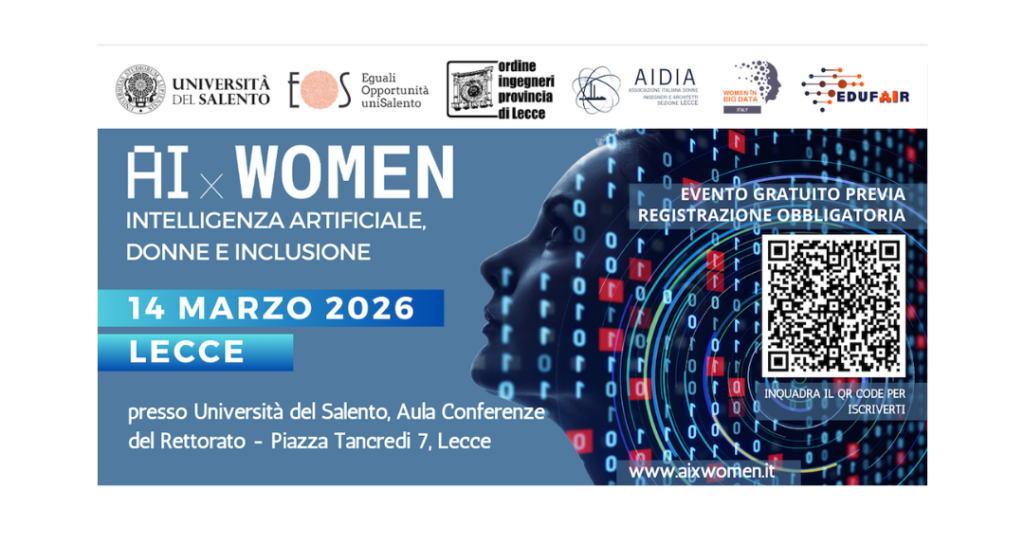
Dopo il successo riscosso nelle principali città italiane, il progetto AIxWOMEN fa tappa a Lecce il prossimo 14 marzo 2026. L’evento, focalizzato sulla formazione e sull’inclusione digitale, nasce dalla collaborazione tra Donne 4.0, l’Università del Salento e l’Ordine degli Ingegneri di Lecce, con il supporto di AIDIA e Women in Big Data Italy.
L’iniziativa mira a colmare il divario di genere nelle tecnologie emergenti, offrendo strumenti per un accesso consapevole alle potenzialità dell’AI.
Il programma ricco e articolato di interventi, è volto a promuovere la consapevolezza e l’accesso equo alle competenze nel campo dell’AI. Sono previsti contributi di professioniste attive in diversi ambiti applicativi – industria, sanità, pubblica amministrazione – e approfondimenti a cura di docenti dell’Università del Salento sugli aspetti etici dell’Intelligenza Artificiale e sulle applicazioni in ambito education.
L’evento si svolgerà sabato 14 marzo 2026, dalle 9:00 alle 13:30, presso Aula Conferenze del Rettorato, Università del Salento – Piazza Tancredi 7, Lecce.
Partecipazione gratuita previa iscrizione qui o inquadrando il qr code.
In today’s world, technology grows faster than any of us can follow, and artificial intelligence is suddenly part of everyone’s life. Thanks to huge improvements in computers and the explosion of big data, large language models have become so advanced that it’s basically impossible to avoid them. Everyone, even my grandma, has interacted with an LLM at least once and she doesn’t even know what “LLM” stands for.
But with great power comes great responsibility. Yes, data is a kind of universal language. But it also carries big risks: unfairness, lack of inclusiveness, and a lot of hidden biases.
I’m Maryam, an Iranian AI specialist working in an international consulting firm in Milan. My daily job is about mixing technology with business and helping companies understand how to use AI wisely. I moved to Italy around four years ago to study computer science, and somehow destiny decided I should stay here. So here I am, still hanging around, still learning, still building.
When I entered Italy, everything was new. I came with my own culture, studied in English, bought groceries in Italian, and lived with international students from all over the world on campus. Every single thing was different, and I had to adapt. And that’s exactly why I started noticing how culture affects the way we think, even the way we think about AI.
Because of my job, I always work with different AI models. And let’s be honest, most of them are built in Western countries, trained on Western data, and shaped by Western perspectives. So of course they struggle with anything outside that bubble.
Ask them something about a smaller ethnic group in Africa? Maybe they were never trained on it. Talk to them in a non-English accent through voice assistants? Good luck! they pronounce Italian with a weird American twist. These small things made me realize a bigger truth, AI often doesn’t understand cultures that didn’t build it.
And the bias doesn’t stop at culture, it hits gender too, in ways that are subtle but incredibly powerful. For example, ask an AI model to describe a “software developer,” and mostly it imagines a man. Ask it for an image of a nurse, and suddenly it’s always a woman. So, a girl who dreams of becoming an engineer might notice that an AI model doesn’t automatically picture someone like her. And a boy who wants to be a nurse might feel like he’s choosing something unusual, because the AI keeps showing it as a “female job.”
For most of history, women weren’t even allowed to study, work freely, or choose their own path. Many professions were legally or socially restricted to men. So of course, the historical data shows “software developer = man”, because only men were permitted to do those jobs in the past. And when you look at roles like nursing, they appear more “female” in old data because during wars men were fighting and women were the ones caring for the wounded.
Again, not because of talent or ability, but because society decided who was allowed to do what. In some periods of history, even a curious, educated woman could be punished, silenced, or called a “witch” simply for thinking differently. That’s the kind of world this old data comes from. So, when AI models repeat those patterns, they’re not reflecting our present, they’re repeating a past where choice wasn’t equal.
Without even realizing it, these systems can shape imagination, confidence, and even identity, especially for younger generations who use AI every day. Kids widely use AI now too, it’s everywhere, so what AI “thinks” actually matters. We need to educate people on how to use AI responsibly, but we also need to improve what we feed into these models. It turns stereotypes into “facts.” And the problem isn’t that the model is evil, the problem is that it has learned from years and years of human data that already carries these biases.
This is why updating the data matters. This is why changing mindset matters. And this is why we need more women, from every background and culture, involved in building AI from the start, inside the rooms where these systems are built. Not afterwards, not as “correctors,” but from the beginning.
We need more unbiased data, and new data that actually includes everyone, every gender, every culture, every story. Because AI can only reflect the world it sees, and right now it sees only a small part of it. To balance these old biases, we need people who bring different histories, different languages, different ways of thinking. People who can look at a dataset and say, “Wait, something is missing here.” People who understand what it feels like to not be represented.
And it’s not only about who builds the technology, but also about who uses it. AI learns from us; The more people use it, the more perspectives it absorbs. So, we need to make AI accessible to everyone, not just a privileged group. We need kids, adults, immigrants, seniors, women, minorities, all voices, interacting with it. That’s how we push it toward fairness.
But access alone is not enough. People need to be educated on how to use AI, how to question it, and how to guide it. Because the better humans understand how to ask, the better AI can learn how to answer. Healthy usage from diverse groups can help correct old patterns and teach the system new ones.
This isn’t just a technical challenge; it’s a human one. AI becomes fair when the people building it and the people using it are diverse enough to notice what others might overlook. The next generation of AI has to be built by all of us. Immigrant women, cultural minorities, people from places the old data never wrote about, we all have something essential to add. Our voices are not “nice to have.” They’re the missing pieces. And if we show up, use the tools, and shape them with our own hands, we can create AI that finally sees the whole world, not just the part that wrote the history books.
That’s the future I want to help build.
Our story matters. Bring it. Be visible. Shape the systems.
Maryam Asgari, AI Specialist & Ambassador Donne 4.0
Il giorno 𝟐7 𝐒𝐄𝐓𝐓𝐄𝐌𝐁𝐑𝐄, nell’ambito di 𝐑𝐎𝐌𝐇𝐀𝐂𝐊 𝟒𝐊𝐈𝐃𝐒, sessione all’interno dell’evento “RomHack Conference Training Camp”, Donne 4.0 terrà un laboratorio di intelligenza artificiale dedicato ai bambini e ragazzi dagli 8 ai 15 anni.
Un entusiasmante incontro di introduzione all’intelligenza artificiale e creazione di videogiochi utilizzando la piattaformaPictoblox – un tool simile a Scratch con delle estensioni specifiche per l’intelligenza artificiale (es. face detection, object detection e machine learning).
L’Intelligenza Artificiale sta offrendo grandi opportunità per migliorare, semplificare, automatizzare molte professioni e ne sta creando di nuove.
Le donne però sono poco presenti in questo mondo e rischiano di non poter cogliere queste opportunità o, peggio, di restare senza lavoro.
Donne 4.0, con il progetto AIxWomen, vuole offrire un’opportunità di re-skilling e up-skilling per il maggior numero possibile di donne in tutta Italia.
La faculty è tutta al femminile, per mostrare che le donne competenti in AI ci sono.
Oggi abbiamo il piacere di annunciare la prossima tappa di AIxWomen che sarà effettuata in collaborazione con l’Università degli Studi di Milano-Bicocca.
Si terrà Sabato 20 Settembre a partire dalle ore 9:00 presso l’aula U6-10, Edificio U6 – Agorà , Università degli Studi di Milano-Bicocca, via dell’Ateneo Nuovo 1, Milano.
La partecipazione è gratuita previa iscrizione a questo link
Il prossimo 15 Settembre 2025 alle 18 si svolgerà l’evento AI & Leadership in Sanità organizzato da Leads in collaborazione con women@AWS presso Amazon Italia, in via Montegrappa 2 a Milano, a cui parteciperà come speaker la nostra Presidente Roberta Russo.
In Italia solo il 18% delle organizzazioni ha adottato tecnologie di intelligenza artificiale, contro il 25% della media europea. Il settore sanitario è destinato a guidare la crescita nell’adozione della GenAI, con un tasso annuo composto dell’85%.
LEADS e BCG presentano i risultati di una ricerca esclusiva su AI e leadership nel settore sanitario esplorando lo stato attuale di adozione e le opportunità che riguardano il futuro . Un momento unico per confrontarsi con esperti, istituzioni e aziende su progetti avviati e come guidare il cambiamento grazie alle nuove tecnologie.
Donne 4.0 sarà presente all’evento organizzato da Richmond Italia, AI Business Forum, che si svolgerà a Gubbio dal 2 al 4 luglio presso Gubbio Park Hotel ai Cappuccini.
Il giorno 4 luglio alle ore 10:15 la nostra Ambassador Valentina Ravenni interverrà nel panel Bias-aware, cyber-ready: un framework per un’AI sicura, etica, inclusiva e resiliente. Affrontare bias e minacce cyber per un’AI realmente affidabile.
L’AI promette efficienza, velocità e automazione. Ma è davvero neutrale e inclusiva? E soprattutto: è sicura? Sempre più spesso, algoritmi affetti da bias o esposti a minacce cyber generano danni reputazionali, decisioni scorrette e rischi legali. Per questo è fondamentale affrontare i “rischi invisibili” dell’intelligenza artificiale: i pregiudizi nascosti nei dati e nei modelli, e le vulnerabilità che l’AI può subire o sfruttare. A partire da casi reali e impatti concreti sul business, verrà presentato un framework operativo che integra data governance, AI security, explainability e accountability organizzativa. Un approccio pratico e trasversale, pensato per aiutare imprese e decision makers a progettare sistemi AI affidabili, trasparenti, controllabili, etici e inclusivi. Perché trasformare il rischio in vantaggio competitivo è possibile, se sappiamo dove guardare.
Il futuro si incontra a Milano. Il prossimo 11 giugno, il Teatro Alcione, ex Maison Versace, ospiterà il Metaverse Generation Summit, evento pensato per chi vuole capire e attivare le potenzialità dell’extended reality nelle aziende. L’obiettivo è integrare tecnologie come Metaverso, AR, MR, XR e Intelligenza artificiale nei processi aziendali, con una visione strategica e orientata al business e al risultato.
Ideato e promosso da XMetaReal, azienda attiva nella progettazione e sviluppo di soluzioni custom di extended reality integrate con Ai per aziende corporate, il summit si propone di accelerare il dialogo tra pubblico e privato e mostrare come queste tecnologie stiano già riscrivendo la comunicazione, il marketing, la customer experience e persino i processi industriali.
La nostra Presidente Roberta Russo parteciperà in qualità di Focus Voice.
Il prossimo 3 giugno la nostra Presidente Roberta Russo interverrà al Convegno Potenzialità e sfide dell’Intelligenza Artificiale, organizzato dalla Regione autonoma Valle d’Aosta e dedicato agli studenti delle scuole superiori, con uno speech dal titolo “Intelligenza Artificiale etica e inclusiva“.
L’evento si svolgerà presso la Sala Ida Maria Viglino, Palazzo Regionale di Aosta.
Il 28 maggio 2025 alle ore 11:30 fino alle 13:30 si terrà il secondo di un ciclo di incontri su “Intelligenza Artificiale per la sanità e le cooperative – Strategie, applicazioni e innovazione”nell’ambito del progetto IN.NO.CARE ideato da Node soc. coop., società del sistema di Confcooperative, insieme alla federazione Confcooperative Sanità.
Il modulo sarà ricco di contenuti su AI generativa, telemedicina, sicurezza e automazione, grazie alla sinergia tra NODE, Donne 4.0 e il Prof. Sergio Pillon, pioniere della sanità digitale.
Per Donne 4.0. interverranno le nostre Ambassador:
– Francesca Sernissi – Esperta in telemedicina e startup HealthTech
– Silvia Pinciroli – Responsabile sviluppo e soluzioni Digital Medicine
– Marilena Hyeraci – Avvocata specializzata in privacy e cybersicurezza
Ancora una volta, si conferma l’importanza della collaborazione tra esperti e professionisti del settore per un futuro più innovativo e sicuro nella sanità digitale.