My name is Maria Strada, and if I had to tell you my story in a few words, I would say I am a “Negotiator of Peace” with a passion for innovation and people. I graduated in Law from the University of Trento in 1999, focusing on Transnational Law, and for over twenty years, I have lived immersed in the world of technology. I have led international teams and managed complex deals for giants like Google Cloud and HP. But what truly drives me isn’t just the rigor of contracts or the magic of digital tools: it is the intersection of these worlds and the people who have always been the engine behind it all.
Imagine three intertwined threads—contracts, technology, and human relationships—forming the fabric of my career. We often see them as separate, but to me, they are inseparable: technology gives us speed, contracts provide structure, but it is people who breathe life into lasting relationships.
We live in a fascinating yet paradoxical era. Artificial Intelligence is revolutionizing everything: it processes data at an impressive speed, standardizes processes, and makes them cost-effective. As Lawyer Angelo Monoriti notes in his article on the “Right to Human Interaction” (cit.: The Right to Human Interaction, by Angelo Monoriti, Professor of Negotiation, Luiss Guido Carli, Federalismi.it, September 10, 2025), AI is a master of “commoditization”—it makes everything fast and predictable. However, there is a chasm between a perfect calculation and a true agreement. AI provides the logical clause based on millions of data points and probabilities, but it is a static output: if the variables change, it collapses. It does not create trust, it does not mediate conflicts, and it does not generate that bond capable of weathering the storms.
This is where the human element becomes irreplaceable. AI learns from the past and, if left unchecked, risks perpetuating outdated biases. Negotiation, however, is the art of listening, mediation, and inclusion. It’s not just about clauses; it’s about resolving conflicts with empathy.
As an ambassador for Donne 4.0, I carry this passion at the heart for the mission: overcoming the gender gap through digital technologies. I firmly believe that AI must not replicate the mistakes of the past but evolve toward an equitable future. Female leadership plays a crucial role here: by bringing a perspective centered on empathy and relational intelligence, we can ensure that technology remains a tool for empowerment rather than a mirror of old inequalities.
But this is a collective mission. Everyone can contribute by reclaiming their role as an ethical compass. We must guide the younger generations to understand that technology is a responsibility, not just a utility. I want to inspire young professionals to realize that their human sensitivity is the only force capable of correcting the machine. True inclusivity is not a checkbox; it is a living principle that requires each of us to prioritize human connection over algorithmic efficiency. Only by fostering these deep, empathetic relations can we guarantee that the digital world remains a space for everyone.
Agreement Born from Human Connection
Think about the primordial need we all have: to feel connected, heard, and recognized by another human being, not by an algorithm. Trust—the currency of a business that lasts—is built this way, in a “human space” where true partnerships are born, creating that “field of attraction” that goes far beyond numbers.
In my vision, AI is a powerful ally: a “super assistant” that frees us from routines, allows us to scale complex ideas, and makes us faster. But relying solely on it for negotiations? That is a massive risk. You might achieve efficient deals, but you will end up with fragile relationships, ready to break at the first unforeseen hurdle. True leadership today means defending human Interaction, using technology to empower us, not to replace us.
Ultimately, while AI flattens and accelerates, humans deepen and consolidate. The real “premium” in the market is offering not an algorithmic price, but an empathetic, deep relationship. This is the challenge I live every day: I run fast with technology, but I stay anchored to people to go the distance. Only a human leader transforms a contract into a partnership that lasts.
In today’s world, technology grows faster than any of us can follow, and artificial intelligence is suddenly part of everyone’s life. Thanks to huge improvements in computers and the explosion of big data, large language models have become so advanced that it’s basically impossible to avoid them. Everyone, even my grandma, has interacted with an LLM at least once and she doesn’t even know what “LLM” stands for.
But with great power comes great responsibility. Yes, data is a kind of universal language. But it also carries big risks: unfairness, lack of inclusiveness, and a lot of hidden biases.
I’m Maryam, an Iranian AI specialist working in an international consulting firm in Milan. My daily job is about mixing technology with business and helping companies understand how to use AI wisely. I moved to Italy around four years ago to study computer science, and somehow destiny decided I should stay here. So here I am, still hanging around, still learning, still building.
When I entered Italy, everything was new. I came with my own culture, studied in English, bought groceries in Italian, and lived with international students from all over the world on campus. Every single thing was different, and I had to adapt. And that’s exactly why I started noticing how culture affects the way we think, even the way we think about AI.
Because of my job, I always work with different AI models. And let’s be honest, most of them are built in Western countries, trained on Western data, and shaped by Western perspectives. So of course they struggle with anything outside that bubble.
Ask them something about a smaller ethnic group in Africa? Maybe they were never trained on it. Talk to them in a non-English accent through voice assistants? Good luck! they pronounce Italian with a weird American twist. These small things made me realize a bigger truth, AI often doesn’t understand cultures that didn’t build it.
And the bias doesn’t stop at culture, it hits gender too, in ways that are subtle but incredibly powerful. For example, ask an AI model to describe a “software developer,” and mostly it imagines a man. Ask it for an image of a nurse, and suddenly it’s always a woman. So, a girl who dreams of becoming an engineer might notice that an AI model doesn’t automatically picture someone like her. And a boy who wants to be a nurse might feel like he’s choosing something unusual, because the AI keeps showing it as a “female job.”
For most of history, women weren’t even allowed to study, work freely, or choose their own path. Many professions were legally or socially restricted to men. So of course, the historical data shows “software developer = man”, because only men were permitted to do those jobs in the past. And when you look at roles like nursing, they appear more “female” in old data because during wars men were fighting and women were the ones caring for the wounded.
Again, not because of talent or ability, but because society decided who was allowed to do what. In some periods of history, even a curious, educated woman could be punished, silenced, or called a “witch” simply for thinking differently. That’s the kind of world this old data comes from. So, when AI models repeat those patterns, they’re not reflecting our present, they’re repeating a past where choice wasn’t equal.
Without even realizing it, these systems can shape imagination, confidence, and even identity, especially for younger generations who use AI every day. Kids widely use AI now too, it’s everywhere, so what AI “thinks” actually matters. We need to educate people on how to use AI responsibly, but we also need to improve what we feed into these models. It turns stereotypes into “facts.” And the problem isn’t that the model is evil, the problem is that it has learned from years and years of human data that already carries these biases.
This is why updating the data matters. This is why changing mindset matters. And this is why we need more women, from every background and culture, involved in building AI from the start, inside the rooms where these systems are built. Not afterwards, not as “correctors,” but from the beginning.
We need more unbiased data, and new data that actually includes everyone, every gender, every culture, every story. Because AI can only reflect the world it sees, and right now it sees only a small part of it. To balance these old biases, we need people who bring different histories, different languages, different ways of thinking. People who can look at a dataset and say, “Wait, something is missing here.” People who understand what it feels like to not be represented.
And it’s not only about who builds the technology, but also about who uses it. AI learns from us; The more people use it, the more perspectives it absorbs. So, we need to make AI accessible to everyone, not just a privileged group. We need kids, adults, immigrants, seniors, women, minorities, all voices, interacting with it. That’s how we push it toward fairness.
But access alone is not enough. People need to be educated on how to use AI, how to question it, and how to guide it. Because the better humans understand how to ask, the better AI can learn how to answer. Healthy usage from diverse groups can help correct old patterns and teach the system new ones.
This isn’t just a technical challenge; it’s a human one. AI becomes fair when the people building it and the people using it are diverse enough to notice what others might overlook. The next generation of AI has to be built by all of us. Immigrant women, cultural minorities, people from places the old data never wrote about, we all have something essential to add. Our voices are not “nice to have.” They’re the missing pieces. And if we show up, use the tools, and shape them with our own hands, we can create AI that finally sees the whole world, not just the part that wrote the history books.
That’s the future I want to help build.
Our story matters. Bring it. Be visible. Shape the systems.
Maryam Asgari, AI Specialist & Ambassador Donne 4.0
The recent preview of the CNEL-Istat report on female employment, titled “Il lavoro delle donne tra ostacoli e opporunità”(Women’s Work Between Obstacles and Opportunities”), paints a far from encouraging picture. Although women’s labor is recognized as an essential component for economic and social development, women in Italy continue to face pervasive and systemic obstacles in accessing the labor market, remaining employed, advancing in their careers, and balancing work and personal life. The country still displays the lowest female employment rate in the EU.
Slow and insufficient employment growth in the face of deep gaps
Despite a positive trend in the labor market in the first half of 2024, with increased employment and decreased female unemployment and inactivity, this numerical growth is seriously overshadowed and nearly irrelevant when compared to the persistent and massive gap with the rest of the European Union. In the third quarter of 2024, the female employment rate in Italy was a full 12.6 percentage points lower than the EU average—the lowest among all twenty-seven member states. The gender gap in employment rate is nearly double the EU average (17.4 points vs. 9.1 points), the highest value among European countries.
Even more concerning are the significant territorial disparities: in Southern Italy, the female employment rate is just over one-third of that in the North and Center. Additionally, 71.3% of the increase in the number of employed women is driven by women over 50, indicating that the growth is not addressing the challenges of female youth employment.
Work vulnerability: a condition imposed, not chosen
The report highlights a shocking higher work vulnerability among women. While about seven out of ten employed men enjoy standard employment (permanent employees or self-employed with employees), only just over half of employed women (53.9%) fall into this category. Nearly a quarter of working women—about 2.5 million—experience some form of vulnerability, compared to 13.8% of men. The main driver of this gap is involuntary part-time work, which affects an astonishing 8.6% of women compared to just 2.5% of men.
Nearly a third of working women are in part-time roles, a percentage that rises to 41% among working mothers aged 25–34. In over 50% of cases, mothers in part-time work cite the need to balance family and work responsibilities as the main reason. A significant proportion (42.1%) work part-time because they could not find full-time work. Work vulnerability is more common among young women, those in Southern Italy, women with low education levels, and foreign nationals.
Motherhood and family burden: the “child penalty” that destroys careers
The impact of motherhood on women’s careers in Italy is dramatic and persistent. Mothers in couples have a significantly lower employment rate compared to single women and to all men, whether single or fathers in couples. In 2023, the employment rate of mothers in couples (aged 15–64) stood at 57.2%, almost 30 percentage points lower than that of fathers in couples (86.3%). This “child penalty” not only drastically reduces the likelihood of finding a job after childbirth, but it also has lasting effects, contributing significantly to the gender employment gap. Eliminating maternity-related penalties could, by 2040, increase the female employment rate by 6.5 percentage points—only 38% of the current gap.
The family burden causes many women to completely withdraw from the workforce, especially those with preschool-age children. Among non-working women, over 7.8 million are inactive (63.5% of all inactive people aged 15–64), with the largest group being mothers in couples (38.6%). Most inactive mothers with children do not seek work due to family responsibilities (62.2%), a reason cited by only 4.8% of fathers. These figures reflect the patriarchal structure of the Italian family, where women’s unpaid domestic and caregiving labor hinders their emancipation. Italy ranks third in Europe for the share of male single-earner couples (25.2% vs. the EU average of 16.1%), a model most common among couples with children.
The chronic lack of early childhood services, especially nurseries and pre-kindergarten classes, makes returning to work even harder. Availability is scarce—especially in Southern Italy—while family demand is rising, leading to waitlists and overwhelmed facilities. Additionally, fathers in Italy make extremely limited use of parental leave, partly due to a system that is less generous than those in other European countries.
Education and careers: the unbreakable glass ceiling
Women in Italy are, on average, more educated than men, yet this greater investment in education does not translate into a labor market advantage. Labor market return indicators are generally worse for women, and Italy continues to show a significant female employment disadvantage at all education levels compared to the rest of Europe.
From the early stages of education, girls tend to choose university majors linked to lower-paying, more humanistic professions, contributing to the wage gap from their first job. Although women made up a majority of new university enrollees (55.5% in 2022/2023), only 20.3% enrolled in STEM fields (Science, Technology, Engineering, and Mathematics). Female representation is particularly low in Computer Science (15.1% women) and Engineering (just over 24%). Although Italy surpasses the EU in overall female STEM enrollment, this is mainly due to higher numbers in natural sciences, mathematics, and statistics—not in key fields like computer science and engineering.
One reason for this educational channeling is the early societal pressure that discourages girls from pursuing scientific fields, which are stereotypically perceived as male. The phenomenon of horizontal segregation persists and has even worsened in recent years. About half of all female employment is concentrated in just 21 professions (e.g., secretaries, sales clerks, caregivers, nurses, cleaners), compared to 53 professions for men. This concentration in lower-status or less career-advancing jobs forms a significant barrier.
The glass ceiling remains unbroken. Women are still underrepresented in leadership positions, both in politics and in the public and private sectors. Although the share of women on the boards of publicly traded companies has grown thanks to legislative intervention (43.1% in 2023), the percentage of female CEOs is only 2.9% in Italy, compared to the EU average of 7.8%. Only 28.8% of active businesses in 2022 were run by women, and these tend to be smaller and employ fewer people.
Women’s average wages remain significantly lower than those of men, with a gap of over €6,000 annually, largely due to the higher incidence of part-time work among women. Two out of three women experienced at least one year of low annual pay between 2015 and 2022, and nearly one in three earned low hourly wages.
Policy implications: the urgent need for deep structural reform
Handling the deep gender imbalances in the Italian labor market requires more than minor adjustments: it demands a comprehensive structural approach, supported by a clear and resolute political and societal will. One of the most urgent priorities is to dismantle cultural barriers that still influence girls’ educational choices, steering them toward less remunerative and traditionally “feminine” fields. A profound shift in societal narratives is needed—one that promotes diverse role models and challenges the implicit stereotypes embedded in family, school, and workplace expectations. At the same time, strengthening family support policies is essential. Services for early childhood, such as nurseries and pre-kindergarten classes, remain limited, especially in Southern Italy, heavily penalising female employment. Parental leave also needs a thorough overhaul: only broader and incentivised use by fathers can help rebalance caregiving responsibilities, still disproportionately shouldered by women. Equally urgent is the need to rethink the tax and welfare system, which often penalises female work, particularly when women are second earners. A fiscal rebalancing is needed to encourage female participation in the workforce without sacrificing redistributive goals. Another key area is working conditions: creating more flexible, genuinely family-friendly work environments and increasing transparency on gender pay gaps are critical steps to strengthening women’s bargaining power and supporting their professional growth. Finally, the climb toward top positions remains hindered by a persistent glass ceiling. To ensure a stronger female presence in middle and senior management, corrective measures such as quotas may be necessary—measures capable of unlocking opportunities that are currently blocked.
Addressing these disparities is not only an ethical imperative—it is also a development strategy. The Bank of Italy estimates that a 10% increase in women’s participation in the labor market—enough to align with the European average—would lead to an equivalent increase in GDP in the long term. Ignoring these inequalities means not only perpetuating a historical injustice but also forsaking an economic and social potential that Italy can no longer afford to waste.
I consider myself a multi-passionate professional working in data, with a growing interest in coaching. While I’ve always appreciated the clarity and structure of data, I’ve become increasingly curious about people: how they think, make decisions, and grow, so I’ve started to explore that through coaching.
These two paths come together in my work, especially in using data to support inclusion and visibility. I’ve mentored at a UN Women datathon in Albania and recently spoke at the Women in Data Flagship Event in London, where I discussed how data and AI can help uncover gender disparities in healthcare.
I’m particularly interested in how data can be used not just to inform, but to challenge bias and create space for underrepresented voices.
In the digital age, data plays a central role in how we design services, allocate resources, and make decisions that shape our societies. We rely on data to build technology, improve healthcare, understand economies, and address social challenges. But what happens when this data doesn’t reflect everyone equally?
This is the core issue at the heart of the gender data gap, a term that refers to the lack of accurate, complete, and gender-inclusive data across many fields. This gap is not just a technical limitation. It can directly influence the effectiveness and fairness of decisions that affect millions of lives.
Why the Gender Data Gap Matters
A recent report by McKinsey & Company, Closing the Women’s Health Gap: A $1 Trillion Opportunity in Women’s Health, highlights the economic and human potential that remains untapped due to systemic gaps in how data is collected and used—particularly in healthcare. The report draws attention to the fact that many common health conditions, such as cardiovascular or autoimmune diseases, affect women differently, yet medical research often defaults to male-centred models.
These differences are not always acknowledged in clinical studies, resulting in data that treats women’s symptoms as “atypical” or less urgent. This can lead to under-diagnosis, delayed treatment, and lower-quality care. The report estimates that addressing these gaps could lead to significant improvements in health outcomes and generate substantial value for societies and economies.
This example illustrates a broader issue: when data doesn’t include diverse perspectives and experiences, the solutions we create may be incomplete or ineffective.
Understanding the Roots of the Gap
To address the gender data gap, it is essential to understand where it comes from. In many cases, several interconnected factors contribute to the issue:
1. Bias in Data and Systems Bias can occur unintentionally when data reflects historical inequalities or when algorithms are trained on unbalanced datasets. If systems are built on biased data, they risk reinforcing existing disparities.
2. Underrepresentation In fields where women and gender-diverse individuals are underrepresented—such as STEM or leadership roles—the available data may not capture their experiences accurately. This leads to conclusions that may not apply universally.
3. Social and Cultural Barriers Real-world inequalities, including access to education, employment, or healthcare, often limit participation. These structural barriers can result in missing data or skewed datasets that do not reflect the full population.
4. Gaps in Data Collection In many cases, data related to gender is either not collected or is collected in overly simplistic ways. This reduces the ability to perform meaningful analysis and can make certain issues invisible in public or private decision-making.
Towards More Inclusive and Accurate Data
Closing the gender data gap is not just a matter of fairness—it is a question of quality and effectiveness. Inclusive data leads to more informed policies, better-designed technologies, and more equitable outcomes.
There are several ways to begin improving how we approach data from a gender perspective:
• Design inclusive data collection practices Ensure that data gathering reflects the diversity of the population and is sensitive to different gender identities and experiences.
• Use comparative analysis Breaking down indicators—such as access to education, healthcare, or financial services—by gender can reveal important patterns and disparities.
• Rely on global benchmarks and research Reports like the Global Gender Gap Report by the World Economic Forum offer valuable insights and help contextualise national or local data.
• Promote transparency and accountability Institutions and organisations can help by being clear about how their data is collected, categorised, and used.
• Support data-driven policymaking Accurate gender data is essential for developing laws, initiatives, and programs that promote equal opportunities in all areas of life.
A Shared Responsibility
The gender data gap is a shared challenge that requires collaboration across disciplines—data science, public policy, healthcare, education, and beyond. Recognising the gap is only the first step. To address it, we must commit to developing tools, methods, and practices that reflect the full reality of the world we live in.
By building awareness and sharing knowledge, we can contribute to a more inclusive and informed future—one where data works for everyone.
If you had asked me at sixteen what I wanted to be when I grew up, I probably would have said: “a writer.” I loved reading, I would lose myself in novels, and science, to me, belonged to a different universe. One I watched from afar, with a mix of curiosity and fear. There weren’t many women scientists in the textbooks, and I didn’t know any “Daniela” in a white lab coat.
And yet, here I am: Professor of Clinical Pathology, head of the Unit of Laboratory Oncology Diagnostics at Federico II, researcher, lecturer, and—yes—still a woman who loves books. Only now, I also read scientific articles and write more papers than short stories.
My journey hasn’t been one of straight lines. At first, getting a degree was more of a challenge than a calling. The early years were incredibly tough: endless lectures, difficult exams, and the constant feeling that I had to prove I was “enough.” Enough competent, enough strong, enough “technical” for a world that often seemed to operate solely on male standards.
I had no female role models. But I had a tenacious instinct. And a deep belief: science isn’t just numbers or protocols. It’s also empathy, intuition, and attention to detail. It’s about listening to people, not just data. And on this ground, I finally began to flourish.
I discovered the clinical potential of cancer biomarkers. That’s when I realized science isn’t just math—it’s humanity. From that moment on, I never stopped: I’ve published over 150 scientific papers, gathered thousands of citations in international publications, and received awards that still surprise and honour me to this day. Every recognition feels like a gentle touch on the shoulder of that girl who once didn’t feel “good enough.”
But my restless soul was seeking more. It sought movement, impact, transformation. That’s how my commitment to innovation was born. I founded two university spin-offs, Elicadea and Robosan, which conduct pioneering research in advanced diagnostics and laboratory medicine automation. These are initiatives where science steps outside the academic halls and becomes real solutions for real people.
These projects embody everything: vision, risk, passion, and collaboration with young researchers who remind me every day why I chose this path.
In 2019, I also had the privilege of being selected by the U.S. Consulate in Naples to participate in the International Visitor Leadership Program (IVLP), the most prestigious professional exchange program in the U.S.—a unique experience where I got to connect with innovators and leaders from all over the world. It was one of those moments that makes you say: “Okay, I’m doing it. And I can do even more.”
And then there’s my commitment to women. Upon returning from the IVLP, I launched in Italy—in collaboration with the U.S. Department of State—the Academy for Women Entrepreneurs program, aimed at providing women with entrepreneurial ideas the knowledge, resources, and network to launch or scale successful ventures.
I work to create spaces where women can express themselves, grow, and feel legitimized in building their own path—even when it’s uncomfortable, unconventional, off the beaten track. Because I know what it’s like to be the only woman in a technical meeting, to feel judged more for the tone of your voice than the content of your ideas. But I also know how powerful sisterhood can be. Women lifting each other up can truly make this world a better place.
Today, when I walk into the lab or step into a classroom, I don’t just bring my titles, my papers, my patents. I bring all my versions of self: the insecure girl, the passionate scientist, the professor who wants to open doors—not close them.
And if there’s one thing I’ve learned, one thing I’d shout to every young woman stepping into science or innovation, it’s this: There is no single way to be a woman. You can be creative, emotional, pragmatic, dreamy, rational, and deeply human—all at once. You don’t have to choose who to be. You can be it all.
My motto? “You don’t have to fit the mold. You can create a new one.”
And if I’m here today, it’s also because I met women and men who believed in me. Now, my mission is to do the same for others. Because truly, we rise by lifting each other.
Daniela Terracciano, Professor of Clinical Pathology and Researcher – University of Naples Federico II
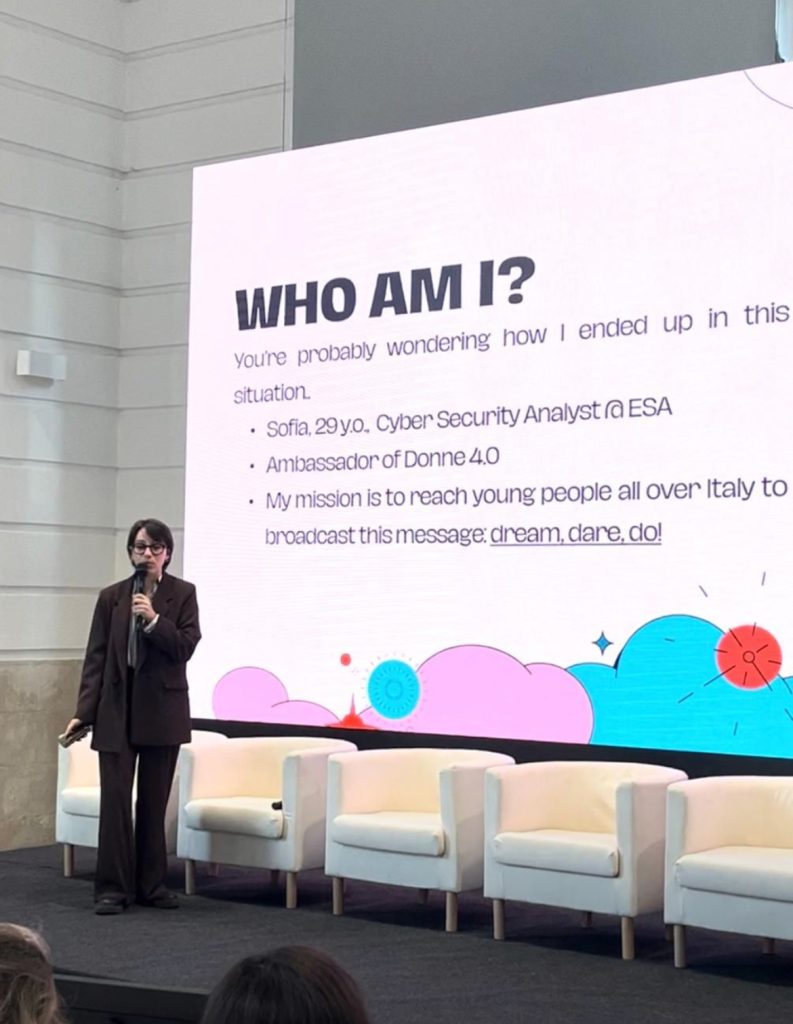
My name is Sofia. I am 29 years old and work as a Cyber Security Analyst, currently serving as a Young Graduate Trainee at the European Space Agency (ESA). My path to this role has been anything but conventional, and it’s a journey defined by challenges, self-discovery, and resilience.
If you had asked me ten years ago what my life and career would look like, I would have confidently said I’d be a lawyer, a librarian, or perhaps a literature professor. These professions aligned naturally with my love for books and writing. However, fate had different plans, and my journey turned out to be one filled with unexpected twists and growth.
Let’s start from the beginning. My relationship with science and mathematics has always been complicated. I remember sitting in my classroom at the age of eight, struggling to understand the purpose of all those numbers and geometric shapes. Homework and tests were a constant source of stress. I clearly recall feeling inadequate compared to my peers, who seemed to grasp that secret language effortlessly. For me, math was an impossible code to crack.
Things didn’t improve much in middle school. I was terrified of my math professor, and my test scores were barely sufficient despite countless hours of studying. My confidence in my ability to succeed in any scientific field waned. On the other hand, I excelled in literature, history, and just about any subject that didn’t involve numbers or formulas. You can probably see a pattern emerging—the same story continued into high school. The battle against mathematics became almost unbearable. Teachers encouraged me to pursue a career in law or classical studies, recognizing my natural comfort and talent in those areas.
At some point, I even became fascinated by the idea of spending my life surrounded by books, pursuing a scholarly path. After all, reading and writing were my passions—what else could I possibly do? Yet, there was a nagging frustration inside me and a tiny voice urging me to deviate from the predictable path. Against all expectations, I made a bold decision: I enrolled in an engineering program after graduating from high school.
You might expect a dramatic turnaround here—a triumphant tale of immediate success. But I’m about to disappoint you. My bachelor’s degree in engineering was nothing short of a nightmare. During the first two years, I managed to pass only two exams, both with low scores. I retook the physics exam nine times and cried more than I care to admit. My parents, while supportive of my stubborn determination, grew increasingly concerned about my well-being. Was this endless studying without tangible results healthy? Was it truly making me happy? Why was I even doing this?
To be honest, my decision to study engineering was driven more by practicality and rebellion than by passion. I wanted to prove to the world—and perhaps to myself—that I could succeed in a field completely unrelated to my natural inclinations. I wanted to demonstrate that I was more than just a bookworm.
After a couple of years, things started to change. I began passing exams, thanks in large part to the support of my colleagues—a diverse group of at-the-time boys who believed in me even when I didn’t believe in myself. We spent countless weekends and nights studying together. Now I’m about to say something unpopular but important: most of my friends and colleagues were genuinely happy when I succeeded. However, there was one instance when I achieved the top score on an exam, and one of my friends didn’t take it well. It was a painful lesson—some men can only support you when you’re struggling, not when you’re thriving.
Through it all, there’s one person I’m most thankful for: myself. I endured the pain, the humiliation of feeling stuck while others progressed, and the constant sense of being in the wrong place. There were days when I questioned everything: Why wasn’t I obsessed with programming languages? Why didn’t I care about unravelling complex formulas or chemical reactions? My solace at the end of the day was reading a good book and making time for friends and family. I was never going to be a stereotypical tech guru, and that’s okay.
The turning point came when I accepted that I didn’t have to be passionate about every aspect of science and technology to succeed. I could be an engineer and still love literature more. This realization was liberating.
Eventually, I earned my bachelor’s degree. It wasn’t with top scores, and I graduated a year late, but I was immensely proud of myself for sticking to my decision. After graduation, life became a rollercoaster of ups and downs. I started working as a web developer but quickly realized it wasn’t for me. I quit and decided to pursue a master’s degree in robotics.
Then the pandemic hit. Studying in isolation was one of the hardest challenges I’ve faced. However, it was during this time that I secured an internship at the European Space Agency. That experience was transformative. Despite the remote setup, I found mentors who invested their time in me and inspiring female colleagues who showed me what I could achieve.
After six months, my internship ended. While finishing my master’s degree, I signed a contract with a company in the aerospace sector. As an apprentice there for 18 months, I faced a demanding and stressful job. Yet, I’ll always be grateful for that experience because it was where I established my first professional support network.
Two incredible female colleagues, L. and M., became my pillars of support. We shared our struggles as engineers and discussed everything—even our salaries, which is still a taboo topic for many. Our openness empowered us to set clearer goals for our professional growth. Even though our career paths have since diverged, we continue to support and motivate each other. We challenge the status quo in a male-dominated industry where it’s still difficult to discuss menstrual leave or be taken seriously without being labelled as emotional or weak. We refuse to be reduced to clichés.
Today, I work as a Cyber Security Analyst at ESA once again. One of the most surprising and empowering aspects of my current role is the strong female leadership in my team. These women exemplify how gentle yet firm leadership can coexist, and they’ve shown me the importance of making thoughtful decisions. Their example has reinforced my belief that I belong in this field, even if I don’t fit the traditional mold of a tech enthusiast.
I made peace with not being a tech guru long ago. My journey is about continuous growth and learning to be kinder to myself. I am enough, just as I am, on this unconventional path of self-affirmation. One of my top priorities will always be finding women I can count on and who can mentor me.
My motto is simple: “We rise by lifting each other up.” This guiding principle shapes how I approach my career and relationships. I hope my story inspires others to embrace their unique journeys, to persevere through challenges, and to support one another in building a more inclusive and equitable world.
Sofia Marzo, Cyber Security Analyst, Donne 4.0 Ambassador
As a young woman passionate about science, I’ve often navigated a dual perspective: one that offers exciting opportunities but also challenges linked to deeply rooted cultural biases that discourage female participation in this field.
STEM subjects, naturally complex and fascinating, have captivated me since primary school. Today I’m studying Computer Engineering at university and, while I frequently find myself pushed to my limits, I am certain that I’ve made the right choice for my future.
Throughout my academic journey I’ve often felt out of place being in a male-dominated space but fortunately, I’ve found support among my girl peers and had the chance to join various initiatives, including AixGirl Summer Tech Camp and other projects led by the association. These experiences have introduced me to more inclusive and progressive spaces where diversity is seen as a strength to embrace.
Because I believe that a key factor in driving change is not getting discouraged but asserting our presence relying on our skills instead, in 2023 I became a tutor for the same project that helped me. I am deeply committed to ensuring other young women like me receive the same support.
Having a strong female network has been invaluable, not just practically, but in giving me hope and inspiring me to be part of change.
STEM is a fast-evolving field that has the power to shape our lives in deep ways, that’s why it’s crucial to ensure that this evolution moves in a positive direction where we claim our rightful seat at the table.
Anna Cosentino, Computer Engineering Student, Donne 4.0 Ambassador
Working in robotics and automation as a woman means constantly challenging the status quo. In an industry still predominantly male, we often find ourselves as the only women in the room. This comes with both challenges and opportunities. The challenge of proving our expertise beyond biases, and the opportunity to drive change through innovation and leadership.
Robotics is about precision, problem-solving, and creativity, all qualities that know no gender. The more women step into this field, the more we reshape perceptions, paving the way for a more inclusive and diverse industry.
Throughout my journey, I have faced skepticism and mistrust, but I have also built a career based on competence, passion, resilience and perseverance.
Thankfully, also incredible support from mentors and peers who believe in the power of diversity.
It is also crucial for male leaders to recognize that men and women approach problems differently. Understanding these differences is essential to fostering an environment where diverse perspectives thrive.
Representation matters, and being a woman in automation is not just about working with machines; it’s about designing the future of technology and ensuring it serves everyone. It’s about inspiring the next generation to see robotics not as a male-dominated space, but as a limitless field where talent and vision define success.
Irene Vetrò, EduTech Specialist Engineer, Donne 4.0 Ambassador