In un contesto culturale che riscontra l’effettiva esistenza di una comunità scientifica caratterizzata nella sua quasi totalità da esponenti maschili, occorre alimentare un movimento culturale per incoraggiare la popolazione femminile – fin dalla più giovane età – ad affacciarsi al mondo scientifico partendo anche dalla dimensione del gioco.
L’ecosistema scolastico è senz’altro il primo interlocutore di riferimento per promuovere equità e inclusione poiché assume un ruolo determinate nel favorire l’avvicinamento delle ragazze alle discipline STEM.
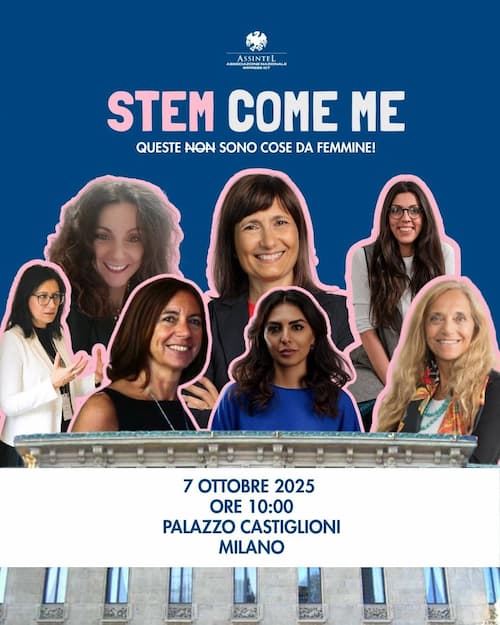
Il giorno 7 ottobre 2025 alle ore 11.00 la nostra Presidente Roberta Russo parteciperà in qualità di speaker alla tavola rotonda dell’evento Piccole Innovatrici Crescono – STEM come MEorganizzato da Assintel che, attraverso il proprio Gruppo di Lavoro InnovationWomen2030, si impegna a promuovere l’inclusione femminile nelle discipline STEM, prevedendo il coinvolgimento di imprese, del sistema scolastico e delle istituzioni interessate al tema. L’evento si svolgerà a Milano presso Palazzo Castiglioni, C.so Venezia 47, Sala Colucci.
L’Intelligenza Artificiale sta offrendo grandi opportunità per migliorare, semplificare, automatizzare molte professioni e ne sta creando di nuove.
Le donne però sono poco presenti in questo mondo e rischiano di non poter cogliere queste opportunità o, peggio, di restare senza lavoro.
Donne 4.0, con il progetto AIxWomen, vuole offrire un’opportunità di re-skilling e up-skilling per il maggior numero possibile di donne in tutta Italia.
La faculty è tutta al femminile, per mostrare che le donne competenti in AI ci sono.
Oggi abbiamo il piacere di annunciare la prossima tappa di AIxWomen che sarà effettuata in collaborazione con l’Università degli Studi di Milano-Bicocca.
Si terrà Sabato 20 Settembre a partire dalle ore 9:00 presso l’aula U6-10, Edificio U6 – Agorà , Università degli Studi di Milano-Bicocca, via dell’Ateneo Nuovo 1, Milano.
La partecipazione è gratuita previa iscrizione a questo link
Donne 4.0 sarà presente all’evento organizzato da Richmond Italia, AI Business Forum, che si svolgerà a Gubbio dal 2 al 4 luglio presso Gubbio Park Hotel ai Cappuccini.
Il giorno 4 luglio alle ore 10:15 la nostra Ambassador Valentina Ravenni interverrà nel panel Bias-aware, cyber-ready: un framework per un’AI sicura, etica, inclusiva e resiliente. Affrontare bias e minacce cyber per un’AI realmente affidabile.
L’AI promette efficienza, velocità e automazione. Ma è davvero neutrale e inclusiva? E soprattutto: è sicura? Sempre più spesso, algoritmi affetti da bias o esposti a minacce cyber generano danni reputazionali, decisioni scorrette e rischi legali. Per questo è fondamentale affrontare i “rischi invisibili” dell’intelligenza artificiale: i pregiudizi nascosti nei dati e nei modelli, e le vulnerabilità che l’AI può subire o sfruttare. A partire da casi reali e impatti concreti sul business, verrà presentato un framework operativo che integra data governance, AI security, explainability e accountability organizzativa. Un approccio pratico e trasversale, pensato per aiutare imprese e decision makers a progettare sistemi AI affidabili, trasparenti, controllabili, etici e inclusivi. Perché trasformare il rischio in vantaggio competitivo è possibile, se sappiamo dove guardare.
The recent preview of the CNEL-Istat report on female employment, titled “Il lavoro delle donne tra ostacoli e opporunità”(Women’s Work Between Obstacles and Opportunities”), paints a far from encouraging picture. Although women’s labor is recognized as an essential component for economic and social development, women in Italy continue to face pervasive and systemic obstacles in accessing the labor market, remaining employed, advancing in their careers, and balancing work and personal life. The country still displays the lowest female employment rate in the EU.
Slow and insufficient employment growth in the face of deep gaps
Despite a positive trend in the labor market in the first half of 2024, with increased employment and decreased female unemployment and inactivity, this numerical growth is seriously overshadowed and nearly irrelevant when compared to the persistent and massive gap with the rest of the European Union. In the third quarter of 2024, the female employment rate in Italy was a full 12.6 percentage points lower than the EU average—the lowest among all twenty-seven member states. The gender gap in employment rate is nearly double the EU average (17.4 points vs. 9.1 points), the highest value among European countries.
Even more concerning are the significant territorial disparities: in Southern Italy, the female employment rate is just over one-third of that in the North and Center. Additionally, 71.3% of the increase in the number of employed women is driven by women over 50, indicating that the growth is not addressing the challenges of female youth employment.
Work vulnerability: a condition imposed, not chosen
The report highlights a shocking higher work vulnerability among women. While about seven out of ten employed men enjoy standard employment (permanent employees or self-employed with employees), only just over half of employed women (53.9%) fall into this category. Nearly a quarter of working women—about 2.5 million—experience some form of vulnerability, compared to 13.8% of men. The main driver of this gap is involuntary part-time work, which affects an astonishing 8.6% of women compared to just 2.5% of men.
Nearly a third of working women are in part-time roles, a percentage that rises to 41% among working mothers aged 25–34. In over 50% of cases, mothers in part-time work cite the need to balance family and work responsibilities as the main reason. A significant proportion (42.1%) work part-time because they could not find full-time work. Work vulnerability is more common among young women, those in Southern Italy, women with low education levels, and foreign nationals.
Motherhood and family burden: the “child penalty” that destroys careers
The impact of motherhood on women’s careers in Italy is dramatic and persistent. Mothers in couples have a significantly lower employment rate compared to single women and to all men, whether single or fathers in couples. In 2023, the employment rate of mothers in couples (aged 15–64) stood at 57.2%, almost 30 percentage points lower than that of fathers in couples (86.3%). This “child penalty” not only drastically reduces the likelihood of finding a job after childbirth, but it also has lasting effects, contributing significantly to the gender employment gap. Eliminating maternity-related penalties could, by 2040, increase the female employment rate by 6.5 percentage points—only 38% of the current gap.
The family burden causes many women to completely withdraw from the workforce, especially those with preschool-age children. Among non-working women, over 7.8 million are inactive (63.5% of all inactive people aged 15–64), with the largest group being mothers in couples (38.6%). Most inactive mothers with children do not seek work due to family responsibilities (62.2%), a reason cited by only 4.8% of fathers. These figures reflect the patriarchal structure of the Italian family, where women’s unpaid domestic and caregiving labor hinders their emancipation. Italy ranks third in Europe for the share of male single-earner couples (25.2% vs. the EU average of 16.1%), a model most common among couples with children.
The chronic lack of early childhood services, especially nurseries and pre-kindergarten classes, makes returning to work even harder. Availability is scarce—especially in Southern Italy—while family demand is rising, leading to waitlists and overwhelmed facilities. Additionally, fathers in Italy make extremely limited use of parental leave, partly due to a system that is less generous than those in other European countries.
Education and careers: the unbreakable glass ceiling
Women in Italy are, on average, more educated than men, yet this greater investment in education does not translate into a labor market advantage. Labor market return indicators are generally worse for women, and Italy continues to show a significant female employment disadvantage at all education levels compared to the rest of Europe.
From the early stages of education, girls tend to choose university majors linked to lower-paying, more humanistic professions, contributing to the wage gap from their first job. Although women made up a majority of new university enrollees (55.5% in 2022/2023), only 20.3% enrolled in STEM fields (Science, Technology, Engineering, and Mathematics). Female representation is particularly low in Computer Science (15.1% women) and Engineering (just over 24%). Although Italy surpasses the EU in overall female STEM enrollment, this is mainly due to higher numbers in natural sciences, mathematics, and statistics—not in key fields like computer science and engineering.
One reason for this educational channeling is the early societal pressure that discourages girls from pursuing scientific fields, which are stereotypically perceived as male. The phenomenon of horizontal segregation persists and has even worsened in recent years. About half of all female employment is concentrated in just 21 professions (e.g., secretaries, sales clerks, caregivers, nurses, cleaners), compared to 53 professions for men. This concentration in lower-status or less career-advancing jobs forms a significant barrier.
The glass ceiling remains unbroken. Women are still underrepresented in leadership positions, both in politics and in the public and private sectors. Although the share of women on the boards of publicly traded companies has grown thanks to legislative intervention (43.1% in 2023), the percentage of female CEOs is only 2.9% in Italy, compared to the EU average of 7.8%. Only 28.8% of active businesses in 2022 were run by women, and these tend to be smaller and employ fewer people.
Women’s average wages remain significantly lower than those of men, with a gap of over €6,000 annually, largely due to the higher incidence of part-time work among women. Two out of three women experienced at least one year of low annual pay between 2015 and 2022, and nearly one in three earned low hourly wages.
Policy implications: the urgent need for deep structural reform
Handling the deep gender imbalances in the Italian labor market requires more than minor adjustments: it demands a comprehensive structural approach, supported by a clear and resolute political and societal will. One of the most urgent priorities is to dismantle cultural barriers that still influence girls’ educational choices, steering them toward less remunerative and traditionally “feminine” fields. A profound shift in societal narratives is needed—one that promotes diverse role models and challenges the implicit stereotypes embedded in family, school, and workplace expectations. At the same time, strengthening family support policies is essential. Services for early childhood, such as nurseries and pre-kindergarten classes, remain limited, especially in Southern Italy, heavily penalising female employment. Parental leave also needs a thorough overhaul: only broader and incentivised use by fathers can help rebalance caregiving responsibilities, still disproportionately shouldered by women. Equally urgent is the need to rethink the tax and welfare system, which often penalises female work, particularly when women are second earners. A fiscal rebalancing is needed to encourage female participation in the workforce without sacrificing redistributive goals. Another key area is working conditions: creating more flexible, genuinely family-friendly work environments and increasing transparency on gender pay gaps are critical steps to strengthening women’s bargaining power and supporting their professional growth. Finally, the climb toward top positions remains hindered by a persistent glass ceiling. To ensure a stronger female presence in middle and senior management, corrective measures such as quotas may be necessary—measures capable of unlocking opportunities that are currently blocked.
Addressing these disparities is not only an ethical imperative—it is also a development strategy. The Bank of Italy estimates that a 10% increase in women’s participation in the labor market—enough to align with the European average—would lead to an equivalent increase in GDP in the long term. Ignoring these inequalities means not only perpetuating a historical injustice but also forsaking an economic and social potential that Italy can no longer afford to waste.
Il 28 maggio 2025 alle ore 11:30 fino alle 13:30 si terrà il secondo di un ciclo di incontri su “Intelligenza Artificiale per la sanità e le cooperative – Strategie, applicazioni e innovazione”nell’ambito del progetto IN.NO.CARE ideato da Node soc. coop., società del sistema di Confcooperative, insieme alla federazione Confcooperative Sanità.
Il modulo sarà ricco di contenuti su AI generativa, telemedicina, sicurezza e automazione, grazie alla sinergia tra NODE, Donne 4.0 e il Prof. Sergio Pillon, pioniere della sanità digitale.
Per Donne 4.0. interverranno le nostre Ambassador:
– Francesca Sernissi – Esperta in telemedicina e startup HealthTech
– Silvia Pinciroli – Responsabile sviluppo e soluzioni Digital Medicine
– Marilena Hyeraci – Avvocata specializzata in privacy e cybersicurezza
Ancora una volta, si conferma l’importanza della collaborazione tra esperti e professionisti del settore per un futuro più innovativo e sicuro nella sanità digitale.
L’evento ASCLEPIO AI è pensato per esplorare come l’intelligenza artificiale stia trasformando e potenziando la scienza, la medicina e la sostenibilità a livello globale. L’evento si svolgerà a Milano, al Centro Congressi FAST.
Donne 4.0 sarà Community Partner dell’evento: due giorni in cui si riuniranno esperti riconosciuti a livello internazionale, professionisti del settore sanitario, ricercatori e innovatori, con l’obiettivo di approfondire le applicazioni dell’AI in ambiti critici per il nostro futuro, come la salute e l’ottimizzazione delle risorse ambientali.
Un momento di valorizzazione della cultura delle scienze mediche e tecnologiche, in una osmosi formativa e informativa tra il settore della stampa nazionale e il mondo della medicina per condividere deontologia professionale e i nuovi scenari applicati alla digital medicine.
Il giorno 30 maggio alle ore 13.00, nella sessione AI & Health Futures, la nostra Ambassador Silvia Pinciroli interverrà nel panel “AI e gender bias” con lo speech dal titolo “AI e Gender Gap in Sanità: L’Innovazione al Servizio dell’Equità”.
Dopo le edizioni di Roma, Napoli e Cosenza, AIxWomen arriva a Torino.
Questa nuova edizione è stata organizzata da Donne 4.0 insieme al CIRSDe, il Centro Interdisciplinare di Ricerche e Studi delle Donne e di Genere dell’Università di Torino.
La giornata formativa ha l’obiettivo di avvicinare le donne al mondo delle tecnologie e dei nuovi temi legati all’Intelligenza Artificiale.
Questa edizione vedrà una prima parte introduttiva con le Ambassador di Donne 4.0 sull’Intelligenza Artificiale, sulla sua relazione con la parità di genere e i transfemminismi, e poi la sua applicazione nella sanità digitale e nella sostenibilità ambientale.
Seguiranno due sezioni curate dall’Università di Torino, con una tavola rotonda su AI e le prospettive disciplinari a confronto, e una con la presentazione di tre progetti significativi su AI: MagIA.news e il progetto PAUSE.
Importante anche la volontà di costruire un progetto condiviso con altre realtà, fuori dal mondo accademico, che sono Torino Città per la Donne e Women in AI Italy.
L’8 marzo 2025, nella Giornata Internazionale per i diritti della donna, si svolgerà a Palazzo Valentini a Roma l’evento MULIER COR MUNDI a cui parteciperà in qualità di relatrice nel panel “𝐃𝐨𝐧𝐧𝐞 𝐞 𝐢𝐧𝐭𝐞𝐥𝐥𝐢𝐠𝐞𝐧𝐳𝐚 𝐚𝐫𝐭𝐢𝐟𝐢𝐜𝐢𝐚𝐥𝐞: 𝐜𝐨𝐦𝐞 𝐧𝐮𝐭𝐫𝐢𝐫𝐞 𝐥𝐞 𝐈𝐀 𝐜𝐨𝐧 𝐜𝐨𝐧𝐭𝐞𝐧𝐮𝐭𝐢 𝐜𝐡𝐞 𝐫𝐢𝐬𝐩𝐞𝐭𝐭𝐢𝐧𝐨 𝐥𝐚 𝐩𝐚𝐫𝐢𝐭𝐚̀ 𝐝𝐢 𝐠𝐞𝐧𝐞𝐫𝐞”, la nostra Ambassador Donne 4.0 Liguria Rosella Scalone.
Questo Forum itinerante si propone di toccare e raggiungere le diverse città che vorranno ospitarlo per creare rete e unione tra tutte le realtà che si occupano a vario titolo dell’universo femminile.
La nostra ambassador Roma, Vanessa Rusci, sarà nelle scuole a parlare di AI e futuro a Grosseto il 26 e il 27 Febbraio.
Il 26 febbraio dalle 17 alle 20 presso ISS polo Bianciardi, Liceo Musicale e il 27 febbraio dalle 12 alle 13 al Professionale Servizi Commerciali di Grosseto.
Gli incontri sono pubblici e saranno presenti i presidi degli istituti superiori della provincia.
GoBeyond 2025, evento di iKN Italy, è la quinta edizione in Italia dedicata all’Ecosistema IT in cui, grazie a un programma creato dai CIO per incrementare l’efficienza, mitigare i rischi e ottimizzare i costi nell’AI Transformation, vengono affrontate in maniera concreta, reale e puntuale le criticità relative al nuovo ruolo dell’IT.
Il 4 marzo 2025 alle ore 10.30, la nostra Ambassador Donne 4.0 Milano Donatella Ardemagni modererà, durante la sessione plenaria, il panel “Anticipare l’innovazione e trasferirla alle aziende: il 2025 è l’anno della real GenAI oltre l’hype?“.
La GenAI è davvero pronta per trasformare i settori chiave o esistono ancora limiti che devono essere superati per renderla rivoluzionaria?
La GenAI è davvero accessibile a tutte le aziende o si tratta di uno strumento elitario?
In che modo l’avvento di DeepSeek ha rimescolato le carte in tavola, anche per l’Europa?
Quali strategie ottimali per trasferire il valore dell’innovazione tecnologica all’utente finale?
Speaker:
Andrea Benedetti – Senior Cloud Solution Architect (Data & AI) Microsoft
Alessandro Marrandino – Data and AI Sales Specialist Google Cloud
Enrico Bussolati – Data-AI-Automation Practice Leader TD SYNNEX
L’evento si svolgerà a Milano, presso l’Hotel nhow.